
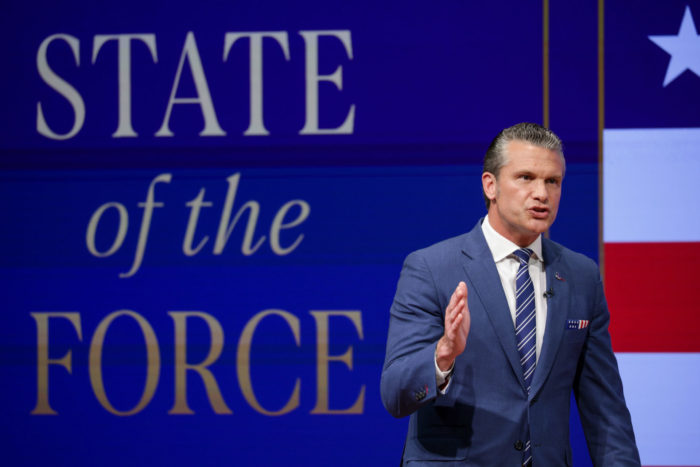
Defense Secretary Pete Hegseth announced sweeping changes to U.S. defense priorities in a “State of the Force” speech at Marine Corps Base Quantico, outlining a new four-star command for autonomous and robotic systems and ordering a 20% reduction in general and flag officers by Jan. 1, 2027, according to Headline USA (adapted from Associated Press reporting).
New drone command and a sharper cut to top brass
Hegseth said the Pentagon will stand up a four-star command to oversee drones and other uncrewed capabilities, calling the effort “the fastest peacetime shift in modern military history,” per the outlet. He argued the military must adapt faster, citing Ukraine’s battlefield improvisation: “Ukraine’s lesson is not that one type of drone wins wars, but rather the need for a purpose-built system that maximizes the ability to adapt,” Hegseth said, per the report.
He doubled last spring’s target for trimming roughly 800 general and flag billets from 10% to 20% by 2027. “I call it accountability and long overdue,” Hegseth said, according to the report.
Pushback on the cuts
Some lawmakers criticized the drawdown. Sen. Mark Kelly, D-Ariz., a former Navy combat pilot, is quoted by the outlet saying, “He’s purging a generation of great leaders of the military, and it’s going to take a generation to recover from it.” Sen. Mike Rounds, R-S.D., said he wanted to review the rationale: “If it’s simply a matter of eliminating a very heavy top, there may be some validity to it, but I want to see it first,” per the report.
Musk, Gingrich, Luckey tapped for war-futures study
The Pentagon will launch a study on the future of warfare to be led in part by SpaceX CEO Elon Musk, former House Speaker Newt Gingrich, and Anduril co-founder Palmer Luckey, Hegseth said, according to the report. He described the goal as discovering, developing, and fielding the systems “our children and our grandchildren will need,” to dominate “any future battlefield, from under the Earth to beyond the moon,” per the outlet.
Strain of the Iran war—and disputed battlefield claims
The speech comes seven months into a war with Iran, with no clear end in sight, during which U.S. forces have used “hundreds” of costly missile interceptors to counter Iranian missiles and drones, the outlet reported. Hegseth “repeated claims” that U.S. operations destroyed Iran’s navy, air force, air defenses, many leaders, and industrial capacity, according to the report. The outlet also reported that Tehran has continued intermittent drone and missile attacks and retained the ability to hit commercial and military ships in the Strait of Hormuz.
Drone urgency amid mixed Army signals
The plans for a drone command arrive as an Army unit in Europe that specialized in drone warfare was ordered to revert to a traditional infantry battalion, the outlet reported. A bipartisan group of lawmakers asked the Army to explain the decision, given the growing use of uncrewed systems, per the report.
Base-building, energy resilience, and a new religious office
Hegseth announced a plan to build a new U.S. military base—the first in roughly four decades—and invited all 50 states to compete to host 15,000–25,000 service members, according to the report. He also outlined a plan to make every base self-powered and said the Defense Department will create an Office of Religious Affairs, per the outlet.
Industrial timelines and space-weapons backdrop
Hegseth touted Trump administration investments and pressure on contractors to speed deliveries, but the outlet reported that experts estimate at least three years are needed to replenish key munitions used in the Iran war. The report also stated that the U.S. this month confirmed for the first time that it had deployed weapons in space.
Reporting source: Headline USA, adapted from Associated Press reporting.